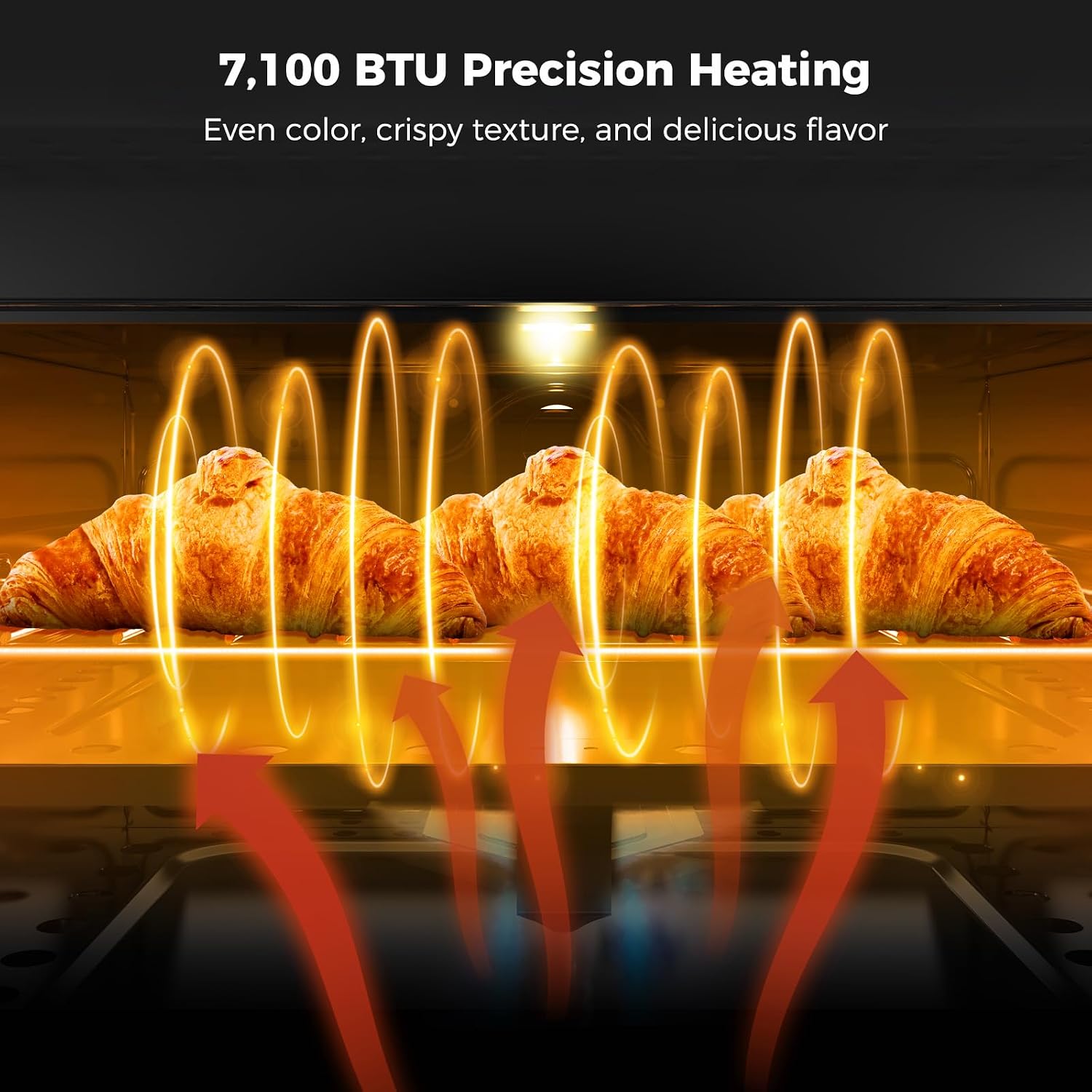
If you’ve ever stood in an appliance store staring at a range’s spec sheet and wondered what “15,000 BTU” actually means in practice — you’re not alone, and you’re asking exactly the right question. A BTU (British Thermal Unit) is simply a measure of how much heat a burner can produce per hour. More BTUs generally means faster boiling and better searing. But in a recreational vehicle, a cabin, or any compact propane-powered kitchen, that single number strips away all the context that actually determines whether a range will serve you well or frustrate you for years. Propane itself (LP gas, or liquefied petroleum gas — the fuel stored under pressure in those familiar tanks) behaves differently than the natural gas most home ranges are built around, and compact installations add a second layer of variables: tank pressure, regulator sizing, ventilation constraints, and physical clearances that the manufacturer’s marketing sheet never mentions. This guide walks through all of it, so you can make a decision you won’t regret six months down the road.
| EDITOR'S PICK[Avanti Gas Range Oven](https://www.amazon.com/dp/B00URHRWGG?tag=greenflower20-20) | Mid-tier[CAMPLUX Classic RV Propane Rang…](https://www.amazon.com/dp/B0D3T1QSXC?tag=greenflower20-20) | Budget pick[AMZCHEF 17 Inch 3-Burner RV Gas…](https://www.amazon.com/dp/B0CGZYTQCZ?tag=greenflower20-20) | |
|---|---|---|---|
| Width | 24-Inch | 17 Inches | 17 Inch |
| Oven Capacity | 2.6 Cu.Ft. | — | 1.24 Cu.Ft. |
| Number of Burners | 4 | 3 | 3 |
| BTU Output | — | 28,100 BTU/Hr | — |
| Ignition Type | Electronic | — | — |
| Storage Drawer | ✓ | — | — |
| Price | $739.99 | $485.99 | $427.49 |
| See on Amazon → | See on Amazon → | See on Amazon → |
Why BTU Ratings Mislead in Mobile and Compact Installations
The BTU figure printed on a burner represents a peak output measured under ideal laboratory conditions — a full tank, warm ambient temperature, and a correctly sized regulator delivering consistent pressure. In real-world propane cooking, especially mobile settings, every one of those variables shifts.
Tank temperature is the first hidden variable. Propane vaporizes inside the tank to create the gas that feeds your burners. When an LP cylinder gets cold — below about 40°F is when owners consistently report the effect becoming noticeable — the vaporization rate slows. The Propane Education & Research Council’s appliance safety documentation notes that a 20-lb cylinder (the standard grill-style tank many compact RV rigs use) can deliver meaningfully reduced output at low temperatures, with a significant drop below freezing. If you’re cooking in a mountain camp in October or a winter cabin, your “15,000 BTU” burner may be performing closer to 10,000–11,000 BTU — enough to notice on a high-heat sear.
Regulator sizing is the second variable most buyers overlook. The regulator is the small device that steps tank pressure down from the high-pressure storage level to the working pressure the appliance expects. For propane ranges, that working pressure is typically 11 inches water column (commonly written “11” W.C.” — a low-pressure measurement equivalent to about 0.4 PSI). If the regulator is undersized for the total BTU load of all your burners running simultaneously, pressure drops and every burner underperforms. NFPA 58, the Liquefied Petroleum Gas Code (2024 edition), specifies minimum regulator capacity requirements precisely because undersizing is one of the most common field failures. Most compact RV regulators are rated in the 30,000–60,000 BTU/hr range — adequate for a single-burner camp setup but potentially marginal when you’re running a four-burner range oven with all elements lit.
The third variable is supply line diameter and length. A longer or narrower gas line creates resistance (called pressure drop) that reduces the fuel volume reaching your burners. This is rarely relevant in a permanent kitchen with a properly sized rough-in, but in an RV or cabin where someone has cobbled together a connection from an existing RV quick-connect port, the supply path may not match what the range expects. This Old House’s coverage of gas range installation consistently flags line sizing as an underappreciated factor, particularly in converted spaces.
The practical takeaway
When comparing BTU specs between compact range models, treat the published number as a relative ranking tool, not an absolute performance promise. A range rated at 9,000 BTU/burner with a robust, properly sized regulator and a fresh 40-lb tank in moderate weather will outperform a 12,000 BTU-rated burner on a cold, aging 20-lb cylinder through a marginal regulator. Spec comparison matters — but system context matters more.
The Compact Range Market: What’s Actually Available and How It Segments
The market for RV and compact propane range-ovens has expanded noticeably since 2023. Understanding how it segments saves you from comparing products that aren’t actually competing for the same job.
24-inch and 20-inch freestanding ranges are the workhorses of this category. Brands like Furrion, Suburban, and Atwood (now Dometic) have historically dominated the RV-specific segment. Their ranges are designed to meet ANSI A119.2, the standard for recreational vehicles published by the RV Industry Association, which includes specific requirements for restraint systems (to prevent the range from shifting while the vehicle moves), igniter reliability under vibration, and oven thermostat accuracy at altitude. Consumer Reports’ gas range buying guide notes that RV-specific models are tested to a different standard than residential ranges — an important distinction when you’re tempted to drop a residential compact range into a travel trailer because it was cheaper.
Residential compact ranges (24-inch) from brands like Blomberg, Summit Appliance, and Fagor are designed for small apartments and secondary kitchens. Many can be LP-converted using manufacturer-supplied orifice kits. Owners in long-run reviews frequently report that these units cook more evenly and hold oven temperature more precisely than RV-dedicated models — because they’re built to tighter residential tolerances. The tradeoff: they’re heavier, not rated for mobile use, and typically lack the tie-down provisions ANSI A119.2 requires.
Two-burner drop-in and countertop propane cooktops (no oven) occupy the lowest price tier and the most flexible installation footprint. Camco, Suburban, and Atwood offer units that drop into a standard RV countertop cutout. These are the right choice if oven cooking isn’t part of your use case, or if your rig already has a separate convection microwave handling baking duty.
By the numbers — compact propane range market tiers (2025–2026 pricing):
| Segment | Typical BTU/burner | Price Range | Key Standard |
|---|---|---|---|
| RV-dedicated (Furrion, Dometic) | 8,000–9,500 | $400–$900 | ANSI A119.2 |
| Residential compact (Summit, Blomberg) | 9,000–12,000 | $700–$1,400 | ANSI Z21.1 |
| Countertop/drop-in cooktop | 7,500–9,000 | $150–$400 | Varies by listing |
Ignition Systems, Oven Thermostats, and the Details That Actually Fail
Here’s where buyers who’ve done one or two purchases in this space start to develop real intuition: the ignition system and oven thermostat are the components most likely to cause regret, and neither one gets much attention in spec sheets.
Ignition systems in compact propane ranges fall into three types. Electronic ignition (battery-powered spark igniters) is the most common in current RV-dedicated models. Standing pilot ignition (a small always-on flame that lights the burner when you turn the knob) is older technology but preferred by off-grid owners who want zero dependence on batteries or electrical systems. Manual piezo ignition (a push-button spark generator that requires no battery) sits in between — no electrical dependency, but requires the user to hold the valve open and push the igniter simultaneously.
Owners in aggregated long-run reviews consistently flag electronic ignition as the most common failure point in RV ranges, particularly in high-humidity coastal environments or rigs that see condensation cycles. The igniter module corrodes or the electrode gap closes. The fix is usually cheap, but the failure is annoying. If battery-independence or low-maintenance operation is a priority — off-grid cabins, seasonal use, winter camping — standing pilot or manual piezo is worth the tradeoff of slightly less convenience.
Oven thermostats in compact propane ranges are notoriously variable. This is documented widely enough that Consumer Reports has flagged it as a category-wide issue. The bimetallic thermostat used in most entry and mid-tier compact propane ovens can drift 25–50°F from the dial setting, and the variance isn’t always consistent — meaning an oven that runs 40°F hot at 350°F may run only 20°F hot at 400°F. Owners who bake consistently in RV settings routinely recommend keeping a standalone oven thermometer (a $10–$15 dial thermometer that hangs on the oven rack) as permanent equipment. This is not a workaround — it’s just how this category works.
At the upper end of the residential compact tier, models from Summit Appliance and Blomberg carry tighter thermostat tolerances and have earned better marks in aggregated reviews for baking consistency. If the oven is doing serious work — bread, pastry, anything that needs precision — the price step up to the residential compact tier is usually justified by thermostat quality alone.
Ventilation, Clearances, and the Code Reality Most Buyers Ignore Until They Have a Problem
Propane combustion produces water vapor, carbon dioxide, and — if combustion is incomplete — carbon monoxide. In a sealed or semi-sealed space like an RV or a small cabin, ventilation isn’t optional; it’s a safety requirement. The Propane Education & Research Council’s installation guidance is explicit: propane cooking appliances in enclosed spaces require adequate combustion air supply and exhaust provisions.
In RV installations, ANSI A119.2 specifies minimum ventilation requirements for the cooking compartment. Most factory-installed RV ranges are already compliant, but when an owner swaps a range or adds a larger BTU unit, the original ventilation design may no longer be adequate. This matters especially when upgrading from a two-burner cooktop to a four-burner range: the total combustion air demand roughly doubles.
Make-up air (the replacement air that must enter the space to compensate for air exhausted by a range hood) is a code requirement that has become more prominent in recent residential editions and is now increasingly referenced in compact installation guidance. In practice, for most RV and cabin applications, this means ensuring that the range area is not fully sealed — a vented range hood or operable window is the minimum. Owners in off-grid forums consistently report CO detector alerts as the first sign that their ventilation is marginal, not dangerous-but-right-at-the-edge. Install a CO detector. This is not a suggestion.
Clearances from combustibles — the minimum distances between the range and surrounding cabinetry or walls — are specified on the range’s installation label and must be met regardless of how tight the installation space is. Compact ranges often get installed in galley configurations where buyers shave clearances to fit. This Old House’s installation coverage repeatedly flags improper side clearances as both a fire hazard and a warranty-voiding condition.
The Decision Framework: If X, Then Y
You’ve done the research. Here’s how to cut to the decision:
If you’re installing in a moving vehicle (RV, trailer, converted van): Buy a unit that explicitly meets ANSI A119.2 — that standard exists for exactly this use case and covers tie-down, vibration, and ignition requirements that residential units don’t address. Furrion and Dometic are the established choices. Accept the thermostat variability; budget for an oven thermometer and plan to calibrate your recipes.
If you’re outfitting a fixed off-grid cabin or seasonal property with no mobility requirement: Move up to the residential compact tier (Summit, Blomberg). The better thermostat and heavier construction pay for themselves in cooking performance. Confirm LP conversion kit availability before purchase — not every residential compact range includes or supports an LP kit, and This Old House’s conversion guidance makes clear that using an improperly jetted range on propane is both a performance failure and a safety risk.
If you’re cooking in cold climates or at altitude: Oversize your regulator relative to your total BTU demand, and consider a 40-lb cylinder over a 20-lb. The Propane Education & Research Council’s documentation on vaporization rates provides the technical basis: larger liquid volume means more stable vaporization in cold conditions.
If igniter reliability matters most (full off-grid, winter use, minimal maintenance tolerance): Specify standing pilot or manual piezo ignition explicitly. Accept that this narrows your model selection. That’s the right tradeoff.
If baking quality is the primary use case: The residential compact tier’s tighter thermostat tolerances are not a luxury — they’re the specification that determines whether your oven is a useful tool or a source of failed bakes. The price difference between the RV-dedicated and residential compact tier is typically $300–$500. That’s a reasonable price for the performance gap.
The BTU number on the box tells you where the ceiling is. The regulator, the tank, the temperature, the thermostat, and the ignition system tell you where you’ll actually live. Buy for the system, not the spec.