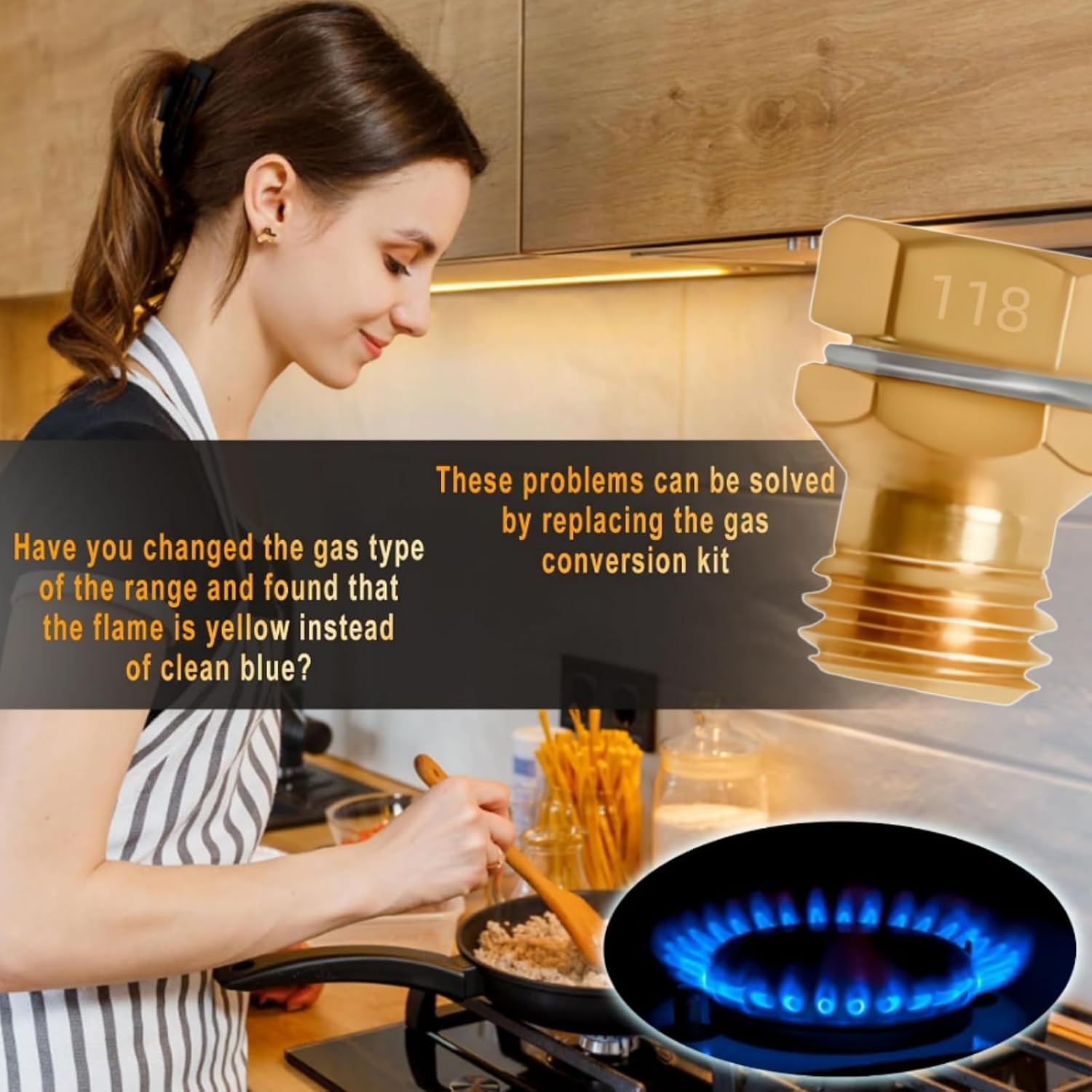
Most gas ranges sold in the United States are set up at the factory for natural gas — a fuel distributed through municipal pipelines at relatively low pressure. Propane, the tank-stored alternative used by rural homes, off-grid cabins, and outdoor kitchens, burns differently: it has higher energy density and arrives at a higher pressure. To run on propane safely, a natural-gas range needs a LP conversion kit — a small collection of parts that re-calibrates how gas enters and burns inside the appliance. This typically means swapping out the orifices (the tiny brass fittings that meter gas flow into each burner), adjusting the pressure regulator, and reconfiguring the broiler and oven burners. Do this correctly and a range performs exactly as designed. Skip it, or use a mismatched kit, and you get yellow, sooty flames, gas that won’t light reliably, and a real safety risk. This article walks through the components that fail most often, the quality differences between kits across the market, and a clear decision framework for choosing right the first time.
What’s Actually Inside a Conversion Kit — and What Each Part Does
Understanding the components is the fastest way to spot a cheap kit before you buy it.
Orifices are the most critical parts. Each burner on your range has one — a brass fitting with a precisely drilled hole whose diameter controls how much gas reaches the flame. Natural gas orifices have larger holes (lower pressure, less energy density); propane orifices are drilled smaller to compensate for propane’s higher pressure and BTU output. If orifice sizing is even slightly off, you’ll either starve the burner (weak, yellow flame, carbon buildup) or overfeed it (roaring flame, scorched grates, potential flashback). The orifice set for a 6-burner professional range will include six surface orifices plus separate pieces for the oven bake burner and broil burner — eight or nine parts minimum.
The pressure regulator — usually already installed on the range — often has a dual-fuel or switchable design: a small cap or internal component is repositioned to change the outlet pressure from approximately 3.5 inches of water column (natural gas standard) to 11 inches of water column (propane standard). Some entry-tier ranges use a fixed single-fuel regulator, meaning you need an external LP regulator on the gas line itself; this is worth confirming before purchase.
Air shutter adjustments come next. Propane burns with a different air-to-fuel ratio than natural gas, and many burners have a small collar or set screw near the venturi tube that controls how much combustion air mixes with the gas. A proper conversion addresses this — though on many sealed-burner designs popular in mid-tier ranges, this step is either minimal or handled automatically by the orifice change alone.
Kits from brand-matched sources (Wolf, BlueStar, Bertazzoni, ZLINE) include documentation specifying exact air shutter positions per burner output level. Generic third-party kits often don’t — a gap that owners of premium ranges consistently report as a source of frustration when flame character still feels wrong after conversion.
Where Conversions Fail: The Real-World Failure Patterns
This is where intermediate practitioners earn their edge. Knowing the failure modes helps you audit a conversion that someone else performed, identify a kit that was under-specified, or set appropriate expectations when managing a DIY install on a cabin property.
Orifice mismatch is the most common failure. Consumer Reports’ 2025 gas range reliability data shows that gas-related service calls spike disproportionately in propane-converted ranges — and technician notes frequently cite incorrect orifice sizing, either because a generic kit was used or because the installer substituted a “close enough” orifice from a hardware bin. The symptom is a persistent yellow or orange flame with visible soot deposits on grates and burner caps. Left unaddressed, incomplete combustion produces carbon monoxide.
Regulator misconfiguration is the second-most-common issue. On ranges with switchable regulators, the conversion step is deceptively simple — flip a cap, replace a label — and it’s easy to miss or to reassemble incorrectly. The Propane Education & Research Council’s installation guide explicitly notes that an incorrectly set regulator is the single most dangerous configuration error in appliance conversion, because it can produce either dangerously high flame output or intermittent ignition that causes gas to accumulate before lighting.
Igniter erosion is a longer-cycle failure that shows up in 18-to-36-month ownership reviews. Propane’s higher BTU output and the hotter flame base it produces accelerates wear on the ceramic igniter tips that surround each burner. Owners of GE and Amana LP-converted entry ranges consistently report igniter replacement as a 2-year maintenance item when running on propane versus a 4-to-5-year cycle on natural gas. This isn’t a conversion kit defect per se — it’s a system-level consequence of propane’s thermal profile — but it’s worth factoring into total cost of ownership.
Third-party kit failures on premium ranges deserve their own callout. BlueStar, in its published LP conversion documentation, explicitly states that using non-OEM orifices voids the range’s warranty and may not satisfy the CSA certification under ANSI Z21.1 / CSA 7.1, the household cooking appliance safety standard. This isn’t boilerplate. BlueStar’s open-burner design with removable brass burners operates at BTU outputs (up to 25,000 BTU/hr on the power burner) where a 0.001-inch orifice diameter error produces a measurable flame quality difference. Wolf’s service documentation makes the same point for its dual-stacked burner system.
By the Numbers
| Range Tier | OEM Kit Cost (typical, 2026) | Generic Kit Cost | OEM vs. Generic Risk Level |
|---|---|---|---|
| Entry (GE, Amana) | $25–$55 | $12–$25 | Low-moderate (simpler burner geometry) |
| Mid-tier (Frigidaire Gallery, Whirlpool) | $45–$80 | $15–$35 | Moderate (more burner count, varied BTUs) |
| Premium (Wolf, BlueStar, Bertazzoni, ZLINE) | $85–$175 | $20–$50 | High (complex burner stacking, warranty void) |
OEM vs. Third-Party Kits: How to Think About the Tradeoff
The price gap between an OEM kit and a generic alternative looks significant until you price a service call. In the current market (May 2026), an appliance technician visit in a rural or semi-rural area — exactly where propane ranges are most common — runs $125–$200 for the visit plus parts. A mismatched orifice set found on a third-party kit could cost you two service calls before the problem is properly diagnosed.
This Old House’s editorial guidance on propane conversion consistently recommends OEM kits for any range still under warranty, and independent technician feedback echoes the same position: generic kits from overseas suppliers often have orifice tolerances that are marginally wider than spec, which reads as acceptable on a caliper but produces real flame quality variance at operating temperature and pressure.
Where third-party kits are more defensible: on out-of-warranty entry-tier ranges at rural rental properties or seasonal cabins, where the operational calculus tilts toward cost minimization. A $15 kit on an Amana 30-inch range that’s already five years old and outside warranty is a reasonable risk — provided you verify orifice sizing against the manufacturer’s LP specs and have a licensed technician perform the final pressure check and flame-character inspection.
The pressure check is non-negotiable regardless of kit source. The Propane Education & Research Council’s installation guide specifies a post-conversion manifold pressure test at the range’s pressure port (using a manometer — a simple pressure-measuring tool that technicians carry as standard equipment) to confirm the regulator is delivering the correct 11 inches of water column. This single step catches the most dangerous failure mode before the range goes into service.
How to Choose the Right Kit: A Decision Framework
By this point you have the vocabulary and the failure modes. Here’s how to translate that into a specific decision.
Step 1: Identify whether your range ships with a kit included. Many mid-tier and premium ranges include the LP conversion kit in the box — it’s a small zip-lock bag taped inside the oven cavity or shipped in a secondary envelope. Frigidaire Gallery models, most Bertazzoni configurations, and ZLINE’s standard lineup all ship with OEM kits. Check the range’s spec sheet or installation manual before ordering separately. Buying a duplicate kit is a minor waste; using a third-party kit when an OEM kit was in the box is the scenario that costs you warranty coverage.
Step 2: Confirm the kit covers every burner including oven and broil. Surface burner orifices get the attention, but the oven bake burner and the broil element are separate burners with their own orifices. A kit that only addresses the surface is incomplete. This is a known gap in some third-party kit listings — the product title says “6-burner conversion kit” but the count covers only the cooktop. Read the component list, not the headline.
Step 3: Match kit to installation responsibility. If a licensed installer is doing the conversion (required by code in most jurisdictions and by nearly all range manufacturer warranties), they will often source the OEM kit directly through a parts distributor and include it in the job cost. If you’re working with a handyman or managing a remote property installation, specify OEM in writing — it’s a $40–$120 cost difference that the property owner should be making consciously, not by default.
Step 4: Plan for the pressure test and documentation. Whether the kit is OEM or third-party, the post-conversion pressure test result should be documented — date, measured manifold pressure, technician name. For rental properties, this creates a paper trail that matters for liability. For high-end home installs under a Wolf or BlueStar warranty, it’s the difference between a covered claim and a denied one.
The Clear Decision Rules
If you’re managing a premium range purchase (Wolf, BlueStar, Bertazzoni, ZLINE) for a client or your own home: use OEM only, source it through the manufacturer’s authorized parts channel, and have a licensed technician perform the conversion and pressure test. The kit cost is trivial relative to the range investment and the warranty protection it preserves.
If you’re outfitting a mid-tier range (Frigidaire Gallery, Samsung, Whirlpool) at a primary residence: use the OEM kit, confirm it covers oven and broil burners, and treat the licensed-tech installation as fixed overhead. Expect igniter replacement around the 2-year mark if propane is the primary fuel.
If you’re managing an entry-tier range (GE, Amana) at a rental, cabin, or seasonal property: a reputable third-party kit is defensible on cost grounds — but only if you verify orifice sizing against the manufacturer’s LP specification sheet, have a licensed tech do the install, and get a documented pressure test. The $15–$25 you save on the kit is not worth bypassing those two non-negotiable steps.
The conversion kit is the smallest line item in a propane range project. It’s also the one most likely to determine whether the range performs safely and reliably for a decade. Treat it accordingly.