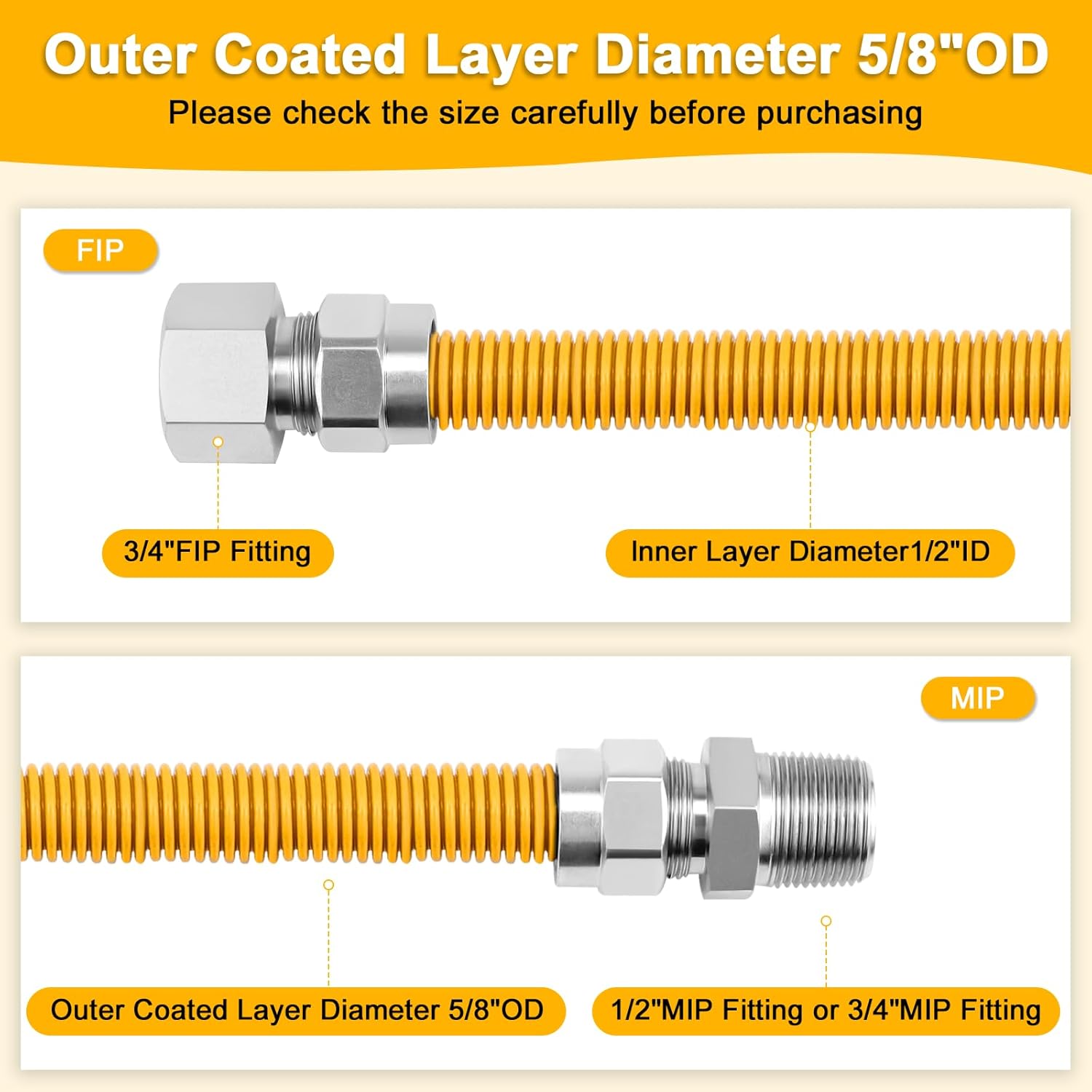
If you’ve ever slid a brand-new range into position and realized you need a short, corrugated metal hose to bridge the gap between the wall gas valve and the range itself — that hose is a flexible gas line connector. Think of it as the last few feet of your propane supply chain: it’s a corrugated stainless steel tube with threaded fittings on each end, designed to absorb the slight movement a range experiences when you open the oven door or pull out a drawer. It sounds simple, but this component is where a surprising number of installations go wrong. Choose one that’s undersized, rated for natural gas only, or installed in a configuration that violates current code, and you’re looking at anything from sluggish burner performance to a failed inspection — or worse. This guide walks through every variable that matters: diameter, BTU capacity, LP-specific ratings, length limits, and the code landscape as it stands in 2026.
| EDITOR'S PICKPROCURU 1" OD x 60" (5Ft) x 3/4… | Mid-tierPuxyblue [2026 NEW] 72" Flexibl… | Budget pickEZ-Fluid 24" Stainless Steel Co… | |
|---|---|---|---|
| Length | 60" | 72" | 24" |
| Pipe OD | 1" | 5/8" | — |
| Connector Ends | 3/4"MIP x 3/4"FIP | 3/4"FIP & 1/2"MIP & 3/... | 1/2"MIP x 1/2"FIP |
| Shut-off Valve | ✓ | — | — |
| EPOXY Coated | — | — | Yellow |
| Price | $56.95 | $25.47 | $17.99 |
| See on Amazon → | See on Amazon → | See on Amazon → |
What Makes a Connector Propane-Specific — and Why It Matters
Here’s the thing most people miss at the hardware store: a connector labeled “gas connector” is not automatically safe for propane (LP gas). Natural gas and propane are chemically different. Propane runs at higher appliance inlet pressures — typically 11 inches water column (in. W.C.) at the manifold, versus 7 in. W.C. for natural gas — and it’s a heavier-than-air gas, meaning any leak pools at floor level rather than dispersing upward. Both characteristics impose stricter requirements on connector materials and certifications.
The certification you’re looking for is listed right on the connector’s label: ANSI Z21.24 / CSA 6.10, which is the joint American National Standards Institute and CSA Group standard covering connectors for gas appliances. Per the current edition of that standard, a connector must be explicitly listed for LP gas use — not just “gas” in general — to be installed on a propane appliance. If the label says “natural gas only” or shows no LP designation, it fails code on a propane installation regardless of its physical dimensions.
The National Fuel Gas Code (NFPA 54), now in its 2024 edition, reinforces this at the installation level: connectors must be listed for the gas being supplied, must not be concealed inside walls or floors, and must be accessible for inspection. The 2024 UMC (Uniform Mechanical Code) carries the same requirement. Both documents are explicit that a connector hidden behind cabinetry or routed through a wall — even partially — is a code violation. This matters for kitchen renovators building custom cabinetry around a range: the connector must remain visible and accessible in its entirety.
Sizing the Connector: Diameter, Length, and BTU Capacity
This is where the practitioner-level math lives. A flexible connector has two sizing variables that interact: inside diameter (ID) and length. Both affect the connector’s flow capacity, measured in BTUs per hour (BTUh). The relationship is not linear — a longer connector of the same diameter delivers fewer BTUs than a shorter one, because friction loss increases with run length.
The three connector diameters you’ll encounter in residential range installations:
| Connector ID | Typical BTUh Capacity* | Common Use Case |
|---|---|---|
| ½ inch | ~60,000–80,000 BTUh | Standard 30-inch ranges, lower-BTU models |
| ¾ inch | ~130,000–175,000 BTUh | High-BTU 36-inch ranges, dual-fuel, commercial-style |
| 1 inch | ~250,000+ BTUh | Outdoor commercial setups, multi-appliance drops |
*Capacity figures reflect published manufacturer specs at 11 in. W.C. LP pressure for connectors 24–36 inches in length. Longer runs reduce capacity; consult the connector manufacturer’s flow table for your exact length.
Let’s put this against real equipment. A Wolf 36-inch dual-fuel range (e.g., the DF366 series) carries a total rated input of approximately 155,000 BTUh. A ½-inch connector at 36 inches of length is undersized for that application — you’ll see reduced flame height on multiple-burner simultaneous use and potentially trigger the pressure-sensing safety on the range. A ¾-inch connector at 24–36 inches handles that load comfortably. BlueStar’s 36-inch RNB series runs similarly high aggregate BTU loads; their LP conversion documentation specifies ¾-inch supply as the minimum. Even mid-tier workhorses like a Frigidaire Gallery 30-inch can push 55,000–65,000 BTUh aggregate, which sits at the upper ceiling of a ½-inch connector — worth checking before defaulting to the smallest option.
The Propane Education & Research Council’s Propane Appliance Installation Guide recommends always calculating the connector’s BTUh capacity against the range’s total rated input (all burners plus oven), not just the primary burner. For an outdoor kitchen with a Lynx or Blaze unit running a main burner, infrared sear zone, and rotisserie simultaneously, that total figure can easily exceed 100,000 BTUh — pushing you firmly into ¾-inch territory even for a single appliance.
Length Limits
NFPA 54 caps residential appliance connectors at 6 feet (72 inches). Most manufacturers publish their own shorter limits — typically 60 inches — in their installation documentation, and the more conservative limit governs. The practical sweet spot for range-to-wall connections is 24–36 inches: long enough to allow the range to be pulled out for cleaning without straining the connection, short enough to minimize flow restriction. Owners in long-run installation forums consistently report that connectors at or near the 60-inch limit show measurable pressure drop on high-BTU burners at maximum output — not a safety issue at code-compliant sizes, but a performance note worth knowing.
LP Conversion Kits and the Connector Question
If you’re converting a range from natural gas to propane — a common move for rural builds, off-grid cabins, and RV-pad installations — the LP conversion kit changes the orifices and regulator at the appliance, but it does not address the connector. That’s a separate purchase and decision. The conversion doesn’t automatically mean your existing connector is wrong, but it does mean you should verify three things:
- The existing connector carries an LP listing. A natural-gas-only connector that was code-compliant before is now out-of-code for a propane appliance.
- The connector hasn’t exceeded its service life. The ANSI Z21.24 standard doesn’t assign a hard expiration date, but the industry standard practice — backed by guidance from the Propane Education & Research Council — is to replace connectors every 5–10 years or any time an appliance is moved. Corrugated stainless can develop micro-fatigue cracks at the bends from repeated repositioning.
- The diameter still supports the range’s aggregate BTU load post-conversion. LP has roughly 2.5 times the BTU content per cubic foot of natural gas, but appliance manifold flow rates are recalibrated by the orifice change — so the connector’s LP-rated BTUh capacity (not its natural gas rating) is what matters.
LP conversion kit quality variability is a known pain point in this community. The Bertazzoni and ZLINE LP kits, for example, include relatively complete documentation specifying connector diameter requirements. Some budget-tier kits — particularly generic aftermarket conversions for GE and Amana entry-level ranges — ship with minimal installation guidance and say nothing about connector sizing. In those cases, fall back on NFPA 54’s pipe sizing tables and the connector manufacturer’s published LP flow charts.
Code Compliance Checklist Before You Call the Inspector
Running through this before your rough-in inspection saves the most time:
Material: The connector must be corrugated stainless steel (CSST connectors are a different product — the corrugated appliance connector is shorter, thicker-walled, and fitted with end fittings, not the long-run yellow-jacketed CSST tubing used for distribution). Uncoated brass connectors for LP are no longer listed under current ANSI Z21.24.
LP listing: Visible on the label. No LP marking = no LP use, period.
Length: 6 feet maximum per NFPA 54; check your local amendment — some jurisdictions enforce a 48-inch maximum.
Accessibility: The full length of the connector must be visible and accessible. It cannot pass through walls, floors, or ceilings.
Fittings: All connections must use listed fittings appropriate for LP service. Teflon tape alone is not sufficient for LP connections — use a gas-rated pipe dope or PTFE tape rated for LP (standard white Teflon tape is not gas-rated).
Shutoff valve: A dedicated manual shutoff valve must be accessible within 6 feet of the appliance, per NFPA 54 Section 9.6. Most inspectors expect it within arm’s reach of the range without moving the appliance.
Seismic requirements: If you’re in California or other seismic zones, the 2024 California Plumbing Code and local amendments may require an excess-flow valve or flexible seismic connector at the appliance. Check your AHJ (Authority Having Jurisdiction — the local body that enforces building codes) before finalizing the spec.
Decision Framework: If X, Then Y
After working through the specs, here’s the condensed decision logic:
If your range is 30 inches or smaller with aggregate BTUh under 65,000: A ½-inch LP-listed connector at 24–36 inches handles the load. Verify the LP listing and you’re done.
If your range is 36 inches, dual-fuel, or commercial-style with aggregate BTUh above 80,000: Go ¾ inch. Don’t negotiate with this — the flow restriction from a ½-inch connector at high demand is measurable, and owners of Wolf, BlueStar, and Bertazzoni 36-inch units who report sluggish burner response at full load frequently trace it back to an undersized connector.
If you’re converting from natural gas to propane: Replace the connector at the same time as the conversion kit, regardless of the existing connector’s age or apparent condition. The LP listing requirement alone justifies it; the low cost of a new connector makes it a non-decision.
If you’re installing an outdoor kitchen with a Lynx, Blaze, or Bull multi-burner setup: Calculate total aggregate BTUh across all zones, consult the connector’s published LP flow table for your run length, and size up if you’re within 20% of the connector’s rated maximum. Outdoor kitchens run at full output more consistently than indoor residential ranges.
If your connector will exceed 36 inches: Pull the manufacturer’s LP flow table for that specific connector SKU and verify the longer-run BTUh figure against your appliance’s total rated input. Don’t assume the standard capacity figure holds — it won’t, and the derating at 60 inches can be significant on ½-inch connectors.
The connector is a $20–$60 part on a $3,000–$10,000 range. Sizing it correctly takes fifteen minutes of spec work. Getting it wrong means a failed inspection at best and a performance-degraded installation at worst. Do the math once, do it right, and it’s off your list permanently.