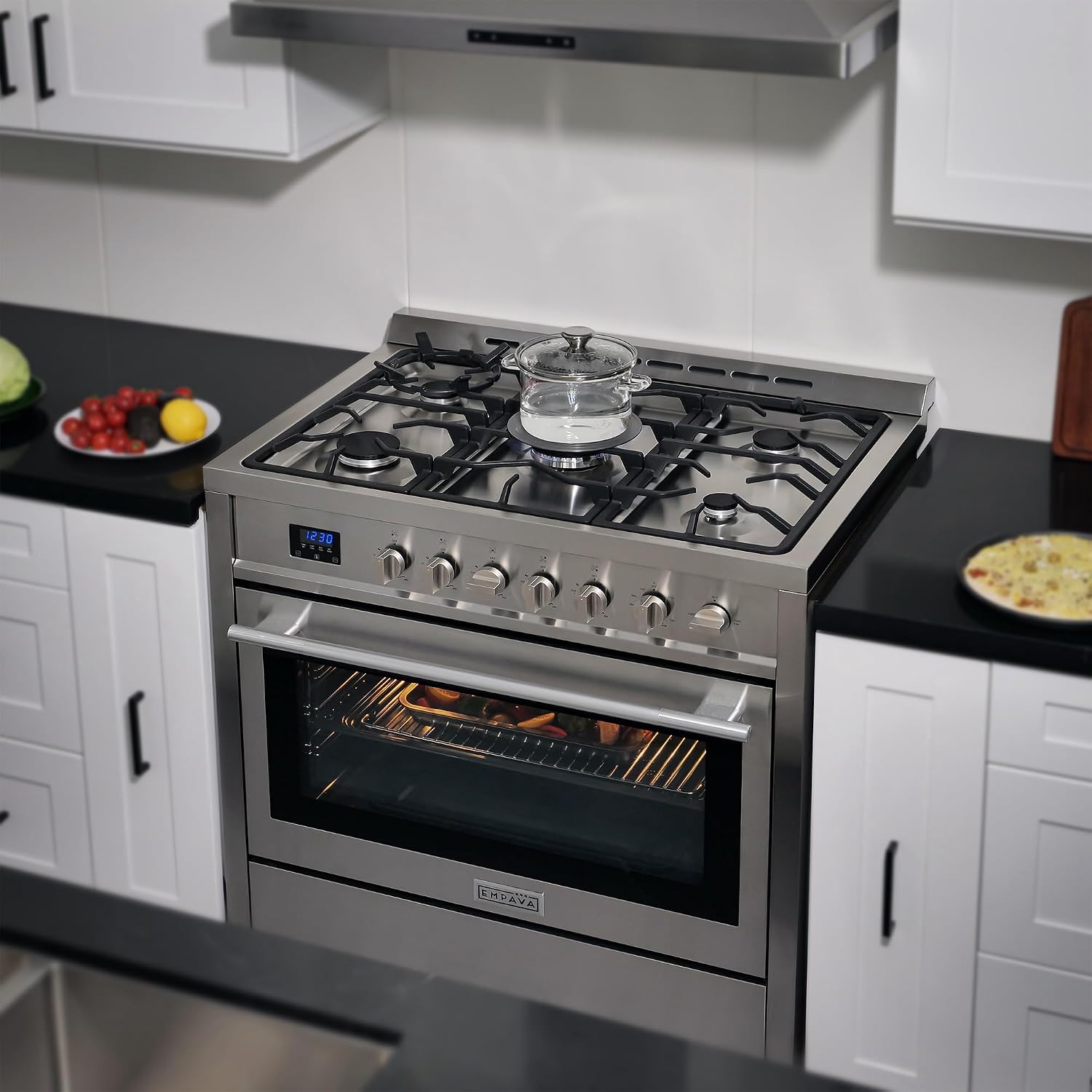
A 36-inch gas range is a freestanding or slide-in cooking appliance that is 36 inches wide — roughly the footprint of a large desktop — rather than the standard 30-inch size found in most homes. The extra six inches makes room for a fifth or sixth burner, a dedicated griddle, or simply wider pots side by side without fighting for space. When people talk about running one of these on propane (also called LP gas, short for liquefied petroleum gas — the fuel stored in a tank outside or on an RV pad, as opposed to natural gas piped in from a utility), there is one extra step involved: an LP conversion kit, a small set of replacement orifices and a pressure regulator that recalibrate the burners for propane’s different energy density. Some manufacturers include that kit in the box; others charge extra or require you to source it separately. Whether a range converts cleanly — or fights you — turns out to be one of the sharpest differences between price tiers. This guide walks the ladder from roughly $1,500 to $4,500, names the tradeoffs honestly, and closes with a decision framework so you can match your budget to your actual situation.
| EDITOR'S PICKAkicon 48" Slide-in Freestandin… | Mid-tier[COSMO GRP366 36 in. Vista Colle…](https://www.amazon.com/dp/B07NLHMXB5?tag=greenflower20-20) | Budget pickRangaire RRG361TS 36" Gas Range… | |
|---|---|---|---|
| Oven Capacity | 6.7 cu. ft. | 5.4 cu. ft. | — |
| Burner Count | 8 | 6 | — |
| Grate Material | Cast Iron | — | — |
| Interior Color | Blue Porcelain | — | — |
| Timer | — | — | ✓ |
| Price | $4,193.00 | $2,438.00 | $1,799.00 |
| See on Amazon → | See on Amazon → | See on Amazon → |
What Changes as You Spend More: The Three Honest Differentiators
Before going tier by tier, it helps to know which variables actually shift with price — because marketing copy muddies this badly.
BTU output matters, but not infinitely. BTU (British Thermal Unit) is the unit of heat energy a burner produces per hour. A higher-BTU burner boils water faster and achieves a better sear. Most serious home cooks want at least one power burner in the 18,000–22,000 BTU range on propane. Above that, the gains are marginal unless you are running a wok station. Where cheaper ranges genuinely hurt is not the peak BTU — it is the simmer: a sealed burner that cannot throttle down below 500–600 BTU without cycling off is a real liability for sauces and chocolate. Premium ranges typically offer continuous-grate cast-iron surfaces and dedicated simmer burners that go down to 140–300 BTU.
LP conversion quality is the propane-specific wildcard. Wirecutter, in its published review “The Best Gas Ranges,” notes that LP conversion quality varies enormously by brand and even by model year within a brand, and that poorly-sized orifices are the leading cause of the yellow, sooty flame that owners report after conversions go wrong. Propane burns best at a lower gas-flow rate than natural gas — the orifice (the tiny brass fitting that meters gas into the burner) needs to be smaller for LP. At the lower end of the price ladder, conversion kits are sometimes afterthought designs; at the premium tier, brands like BlueStar and Wolf build LP as a native configuration with factory-tested orifice sets.
Build quality and longevity compound over time. Consumer Reports, in its “Gas Range Ratings and Buying Guide” (2025–2026 dataset), consistently shows that brands like Wolf and BlueStar carry lower predicted repair rates at the five- and ten-year marks compared with entry and mid-tier brands. The Propane Education and Research Council (PERC), in its “Propane Appliance Installation Guidelines” technical bulletin available at propane.com, also notes that ranges with all-metal valve bodies — rather than plastic-bodied igniter assemblies — hold up better in LP environments where pressure fluctuations are more common than on utility natural gas.
The Price Tiers, Honestly
Tier 1: $1,500–$2,200 — The Capable Workhorse
The clearest names at this level are ZLINE 36-inch ranges and Bertazzoni’s Heritage line, both of which land in the $1,700–$2,100 range at major appliance retailers as of mid-2026. At this tier you are buying Italian-designed aesthetics, a fifth burner, and continuous cast-iron grates — a meaningful step up from a 30-inch consumer range — at a price that does not require a home-equity conversation.
What the reviews consistently surface at this tier: Across aggregated owner reviews on major appliance retail platforms, ZLINE owners frequently cite solid build feel and strong visual presence for the money. The consistent friction point is the LP conversion: ZLINE’s conversion kit has historically required careful attention to regulator pressure settings, and a subset of owners report needing a service call to get flame quality right on propane. Bertazzoni Heritage owners report a smoother LP conversion experience but note that the sealed burners max out around 17,000 BTU on the power burner — adequate but not exceptional.
Serious Eats, in its equipment feature “What to Look for in a Gas Range,” frames the tier honestly: at this price point you are buying the footprint and the burner count of a professional range, but the thermodynamics and igniter systems are still closer to a premium consumer appliance than a true commercial-grade one.
Comparison snapshot — Tier 1:
| Model | Approx. price (mid-2026) | Max BTU (LP) | LP kit included? |
|---|---|---|---|
| ZLINE 36” RA36 class | $1,700–$1,950 | ~18,000 | Yes (verify by model) |
| Bertazzoni Heritage 36” | $1,900–$2,100 | ~17,000 | Yes |
| Frigidaire Gallery 36” | ~$1,500 | ~17,000 | Separate purchase |
If you are here: You have a rural or off-grid install, a renovation budget with a hard ceiling, or a second property where you want the look and burner count of a pro range without the full investment. This tier delivers on those goals. Budget an additional $100–$200 for a licensed technician to complete the LP conversion — this is not the tier where you want to skip that step.

Rangaire
$1,799.00
In stock on Amazon
Check price on AmazonTier 2: $2,200–$3,200 — The Inflection Point
This is where the engineering gap opens up most visibly, and where the decision gets genuinely hard. The primary players are BlueStar’s 36-inch RNB and Platinum series (typically $2,400–$3,000 in LP configuration) and Bertazzoni’s Professional series ($2,300–$2,800).
BlueStar is the name that comes up repeatedly when propane enthusiasts discuss LP-native design. This Old House, in its technical guide “How to Convert a Gas Range to Propane,” identifies BlueStar as one of the few brands that treats LP as a factory-primary configuration rather than a retrofit — their orifice sets are sized specifically for propane pressure rather than adapted from natural gas specs. Owners in long-term reviews consistently describe clean blue flames from day one with no adjustment, which is the benchmark you are chasing on LP.
Manufacturer spec sheets put BlueStar’s power burner at 22,000 BTU on LP — one of the highest available in a residential freestanding range. The simmer burner is rated down to 130 BTU, which owners report handles hollandaise and tempered chocolate without a diffuser plate.
The Bertazzoni Professional series at this tier adds a true convection system — a third heating element surrounding the convection fan, rather than just a fan recirculating ambient oven heat — and tightens build tolerances noticeably compared to the Heritage line. For bakers running a dual-use kitchen, that oven upgrade is meaningful.
The honest tradeoff: BlueStar’s styling is industrial-utilitarian. If you are designing a kitchen around the range as a visual statement, Bertazzoni Professional’s Italian lines read better. If you are designing around cooking performance on propane, BlueStar’s LP engineering is the stronger choice at this price point.
Comparison snapshot — Tier 2:
| Model | Approx. price (mid-2026) | Max BTU (LP) | Notable feature |
|---|---|---|---|
| BlueStar RNB366BV1 (LP) | ~$2,700 | 22,000 | LP-native orifice set, 130 BTU simmer |
| Bertazzoni PROF366 (LP) | ~$2,600 | 19,000 | True convection oven |
If you are here: BlueStar RNB is the clearest propane-performance answer at this tier. Its LP-native engineering and 22,000 BTU output are not matched at the price. If aesthetics are equally weighted with performance, Bertazzoni Professional is a legitimate alternative with a slightly lower propane performance ceiling but a superior oven for baking.
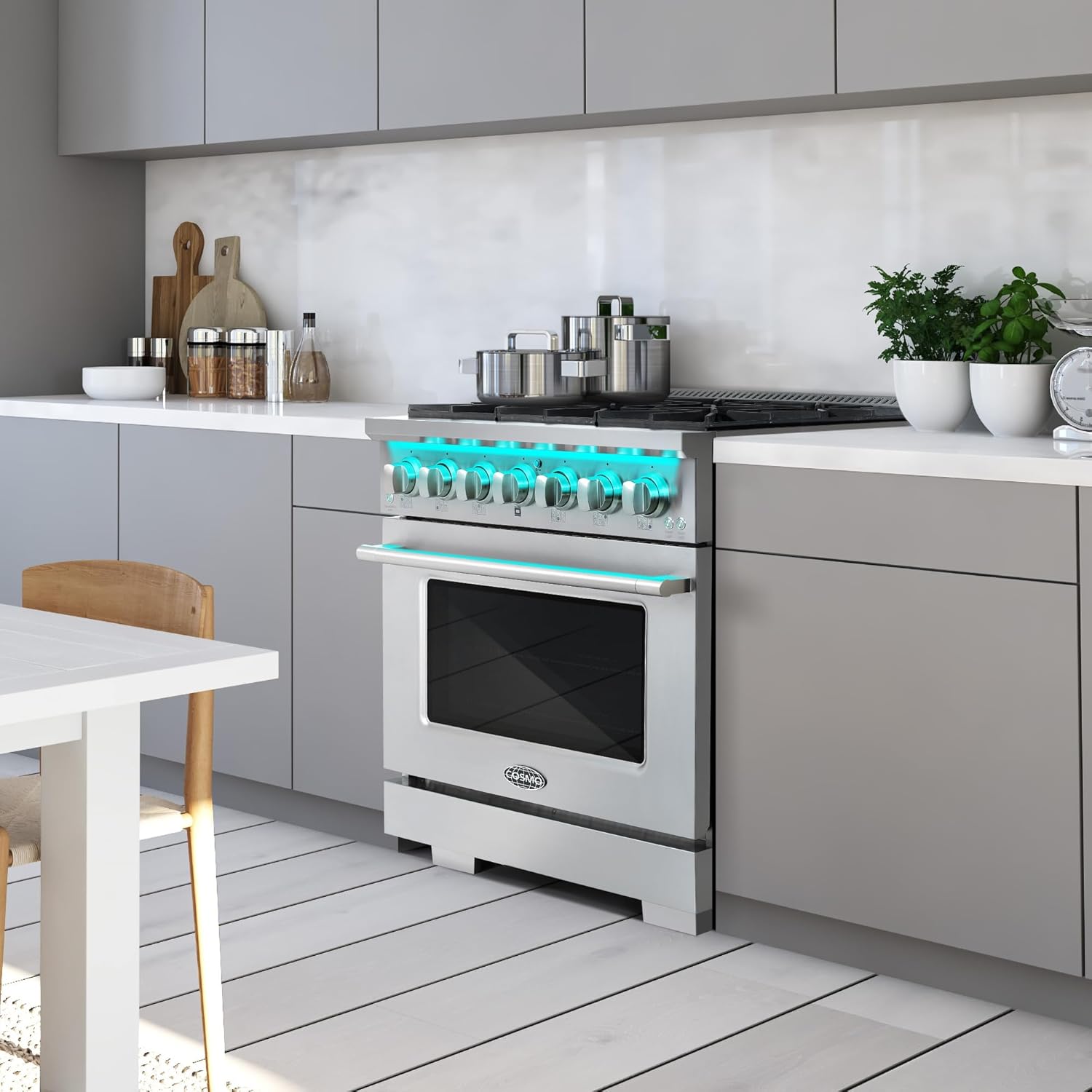
COSMO
$2,438.00
In stock on Amazon
Check price on AmazonTier 3: $3,200–$4,500 — The Professional-Grade Tier
At the top of the range this article covers, the primary competitors are Wolf’s 36-inch Gas Range (GR366) and BlueStar’s Platinum series with expanded configuration options. Wolf lands around $4,000–$4,500 in LP configuration; BlueStar Platinum typically runs $3,400–$3,900 depending on burner layout and color selection.
Wolf’s dual-stacked burner design — a system where two concentric rings of flame fire simultaneously to produce both high heat and a very fine simmer from the same burner head — is the feature owners reference most consistently in long-term reviews. Consumer Reports, in its “Gas Range Ratings and Buying Guide” (2025–2026 dataset), places Wolf at or near the top for predicted reliability in the 5- and 10-year categories for gas ranges, which matters considerably on a $4,000+ appliance. The LP conversion on Wolf ranges is factory-executed when ordered as LP through a dealer; Wolf strongly recommends against field conversion as an afterthought, and most dealers configure the unit before delivery.
BlueStar Platinum adds open burners — no burner cap, direct flame contact with the pan bottom, identical in principle to commercial kitchen equipment — and an expanded color palette of more than 1,000 finish options. For design-forward renovators for whom the range is a kitchen focal point, that configurability is a real differentiator.
What you are actually paying for at this tier: Longevity, LP-native engineering, and reduced service risk over a decade. The Propane Education and Research Council, in its “Propane Appliance Installation Guidelines” bulletin at propane.com, notes that all-metal valve assemblies and sealed igniter housings — standard on Wolf and BlueStar Platinum — meaningfully reduce LP-related igniter failures compared to plastic-housing designs. If this range is going into a primary kitchen that will cook hard for ten years, the cost-per-year math on a $4,200 Wolf versus a $2,700 BlueStar RNB is closer than the sticker prices suggest.
Comparison snapshot — Tier 3:
| Model | Approx. price (mid-2026) | Max BTU (LP) | Notable feature |
|---|---|---|---|
| Wolf GR366 (LP, factory) | $4,000–$4,500 | ~20,000 | Dual-stack burners, top CR reliability |
| BlueStar Platinum 36” (LP) | $3,400–$3,900 | 22,000 | Open burners, 1,000+ color options |
If you are here: Wolf GR366 in LP configuration is the defensible choice for long-term reliability and service support. If open-burner commercial feel or custom color matters as much as longevity, BlueStar Platinum competes directly and often wins on configuration flexibility.
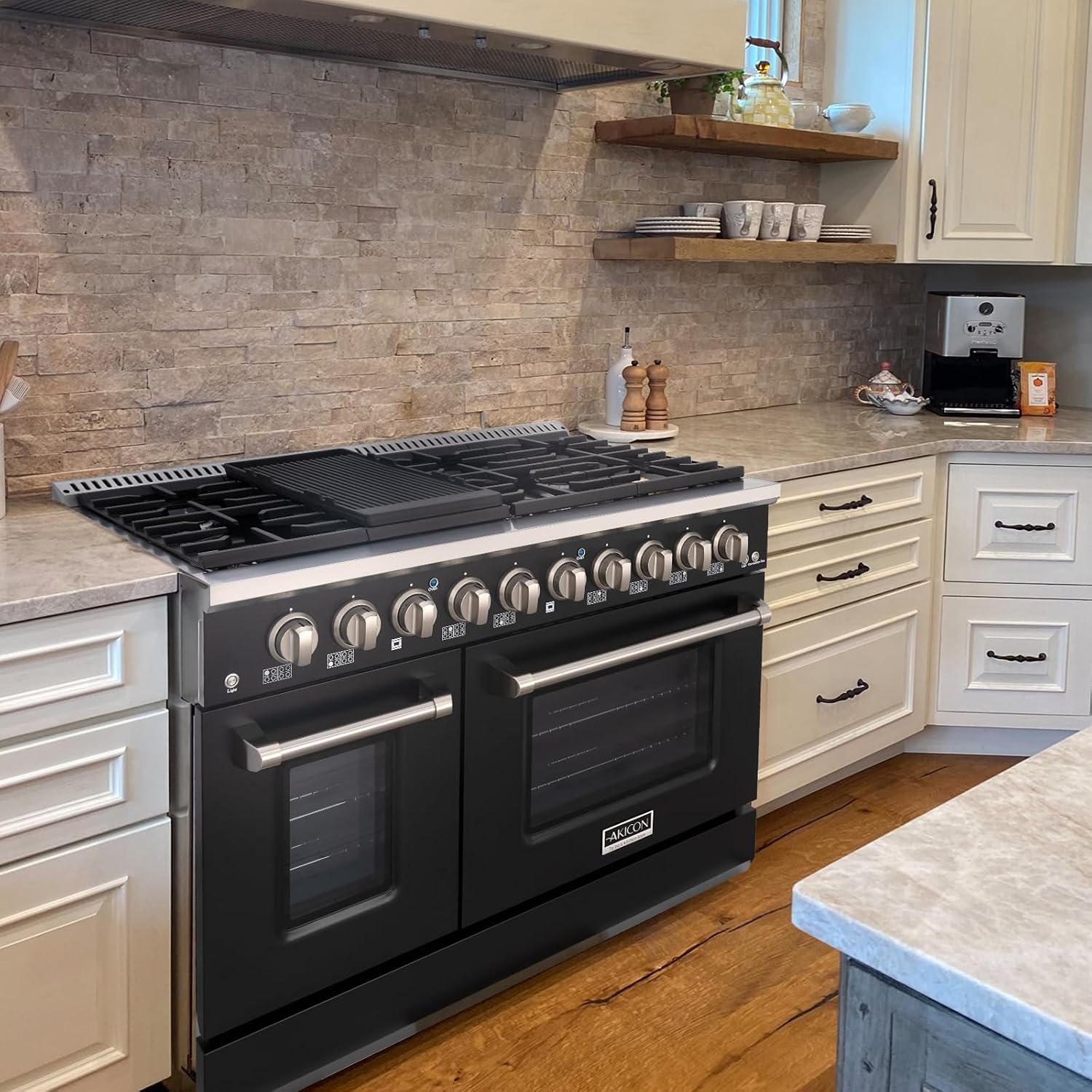
Akicon
$4,193.00
In stock on Amazon
Check price on AmazonThe Decision Framework
If you are sitting with a purchase decision pending, here is the honest if/then map:
If your budget is firm at $2,200 or below and you are doing an LP install: go ZLINE or Bertazzoni Heritage, budget for a technician-executed conversion, and do not expect Wolf-level longevity. You are buying value and footprint, not permanence.
If you are between $2,200 and $3,000 and propane performance is the primary criterion: BlueStar RNB is the clearest answer. Its LP-native engineering and 22,000 BTU output are not matched at the price point. If aesthetics are equally weighted, Bertazzoni Professional is a legitimate alternative with a slightly lower propane performance ceiling but a superior oven for baking.
If you are at $3,200–$4,500 and this is a long-term primary kitchen: Wolf GR366 in LP configuration is the defensible choice for reliability. If open-burner commercial feel or custom finish options matter as much as longevity, BlueStar Platinum competes directly.
One universal rule regardless of tier: Do not skip the LP-specific regulator pressure check after installation. Propane delivery pressure varies by tank fill level and ambient temperature in ways utility natural gas does not. The Propane Education and Research Council, in its “Propane Appliance Installation Guidelines” at propane.com, recommends verifying manifold pressure with a manometer after any LP conversion. This is a twenty-minute step that prevents months of nuisance service calls. Seek an appliance technician who works with propane regularly; a technician trained primarily on natural gas installs may not be familiar with LP pressure verification procedures.
The ladder is real. The gaps are real. But with the right conversion execution and a technician who knows propane, every tier on this list can cook beautifully on LP — the premium buys reliability, native engineering, and the margin for error that comes with both.